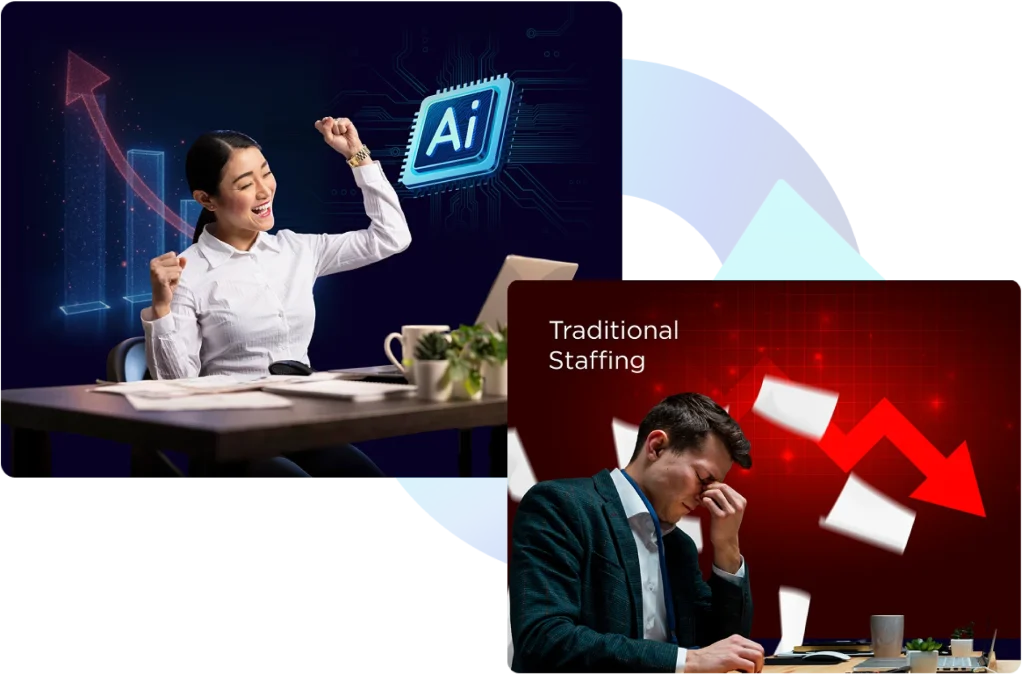
In boardrooms and breakrooms alike, a pressing question has emerged: How can we harness AI to supercharge human talent? The answer isn’t to replace people with machines, but to augment our teams with AI-first capabilities. AI-augmented human talent – professionals equipped with AI “co-pilots” – are proving to vastly outperform traditional staffing models. In fact, the gap is so wide that an AI-savvy team can make even today’s top performers look like calculator users competing against Excel experts . In this thought leadership piece, we’ll explore why AI-first talent is the future of high performance, how industries from engineering to sales are already seeing dramatic gains, and what steps organizations can take to embrace this revolution. Along the way, we’ll highlight Bold Business as a pioneering example of a modern, AI-first staffing partner, and how its AI First QuickStart methodology helps companies transition to a human-centered, AI-powered workforce.
The Productivity Gap Between Traditional Staffing and
AI-Augmented Teams

Just as the internet once split companies into digital leaders and laggards, AI is now creating a new divide with even higher stakes . Traditional staffing approaches, while reliable in the past, simply cannot match the speed, insight, and efficiency of AI-first teams. An AI-first organization builds AI into every role and process by default, rather than as an afterthought. Think of it like speaking a native language versus struggling with a second language – companies born with AI in their DNA will operate with a fluency that retrofitting firms will struggle to match .
 Training People to
Leverage AI at Every Step
NVIDIA’s CEO, Jensen Huang, describes a future workplace where each employee could have thousands of AI assistants at their side.
In other words, tomorrow’s talent might operate with 2,000+ AI agents working in concert on their behalf, drastically multiplying output. No wonder forward-thinking companies see AI-first talent as a competitive superpower. One recent analysis even outlines a path to a 10,000x knowledge worker, achieved by progressing from using single AI tools to orchestrating fleets of AI agents that manage other agents . Most workers today are barely at the first step of this journey – meaning the vast majority of organizations have untapped potential waiting to be unleashed.
In other words, tomorrow’s talent might operate with 2,000+ AI agents working in concert on their behalf, drastically multiplying output. No wonder forward-thinking companies see AI-first talent as a competitive superpower. One recent analysis even outlines a path to a 10,000x knowledge worker, achieved by progressing from using single AI tools to orchestrating fleets of AI agents that manage other agents . Most workers today are barely at the first step of this journey – meaning the vast majority of organizations have untapped potential waiting to be unleashed.