Creating a Positive Ripple Effect For AI

Executive Summary
Business leaders are increasingly grappling with how to implement artificial intelligence effectively. Many organizations default to a macro, top-down approach – creating AI departments, appointing Chief AI Officers, developing grand strategies and governance frameworks. While this strategic oversight is important (especially for large enterprises), it can become bureaucratic and slow . In contrast, a micro, bottom-up approach focuses on empowering individual employees and teams to leverage AI in their daily work, generating quick wins and grassroots innovation . This paper argues that AI adoption flourishes when macro and micro approaches work in tandem, with leadership providing vision and guardrails, and employees enthusiastically embracing AI tools to improve their own productivity. Key insights include:
- Top-down (Macro) AI Initiatives: Ensure strategic alignment, risk management, and resource allocation. However, macro programs alone often struggle with cultural resistance and slow adoption if they don’t engage employees meaningfully . Many CEOs feel pressure to “do something” with AI, yet relatively few organizations have concrete plans or ROI to show.
- Bottom-up (Micro) AI Adoption: Involves democratizing AI – training and equipping staff at all levels to use AI in their jobs. This grassroots approach fosters innovation and buy-in by solving real pain points in the workflow . Early successes at the individual or team level build confidence and a positive AI culture, mitigating fear that AI is merely a top-down productivity mandate.
- Cultural Change & Quick Wins: AI adoption is as much a human and cultural challenge as a technical one . Employees are more likely to embrace AI when it tangibly makes their work easier or more engaging . Quick wins – e.g. an employee automating a tedious report with an AI tool – not only deliver immediate value but also create AI champions who spread enthusiasm to colleagues.
- Integrating Macro and Micro: A bimodal approach to AI implementation combines strong leadership direction with widespread employee empowerment. Leadership must set the tone (e.g. “AI is here to help you, not replace you”), invest in training, and ensure responsible AI governance . Simultaneously, employees should be encouraged (and incentivized) to experiment with AI for day-to-day tasks. Organizations that achieve this integration have seen AI adoption accelerate organically, as bottom-up ideas align with top-down strategy.
In sum, top-down strategies alone are not optimal – companies should complement them with a micro-level AI adoption strategy that puts tools directly in employees’ hands. This approach builds a pro-AI culture and sustainable momentum from the ground up. The following paper delves into the macro vs. micro dichotomy, examines real-world examples (past and present), and proposes a framework for blending both approaches to jump-start enterprise AI success.
Introduction: Two Approaches to Enterprise AI
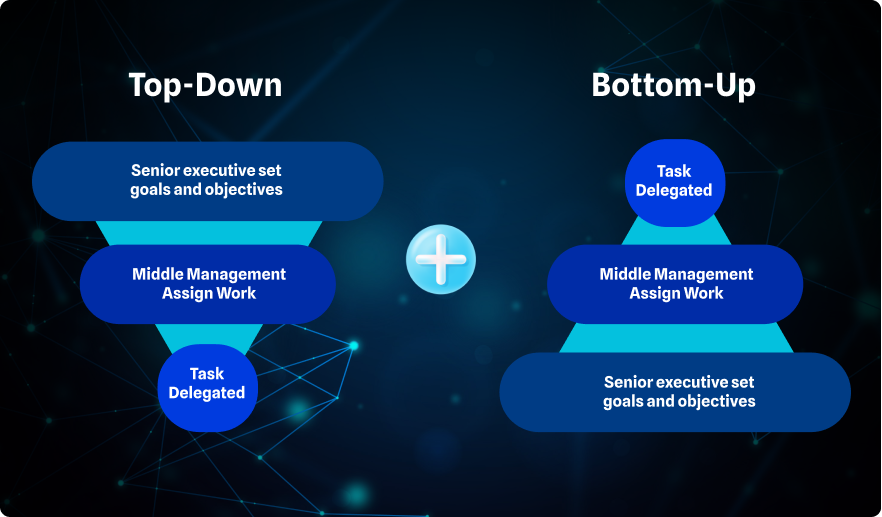
As organizations race to capitalize on artificial intelligence, two distinct implementation philosophies have emerged. The first is a “big picture” macro approach, where AI initiatives are driven from the top. This often involves forming an AI center of excellence or strategy team, appointing senior leaders or Chief AI Officers, and crafting comprehensive plans addressing governance, data security, and enterprise-wide use cases. The second is a “grassroots” micro approach, which flips the script by starting at the ground level – enabling individual employees and small teams to leverage AI tools in their daily tasks and then scaling up these successes.
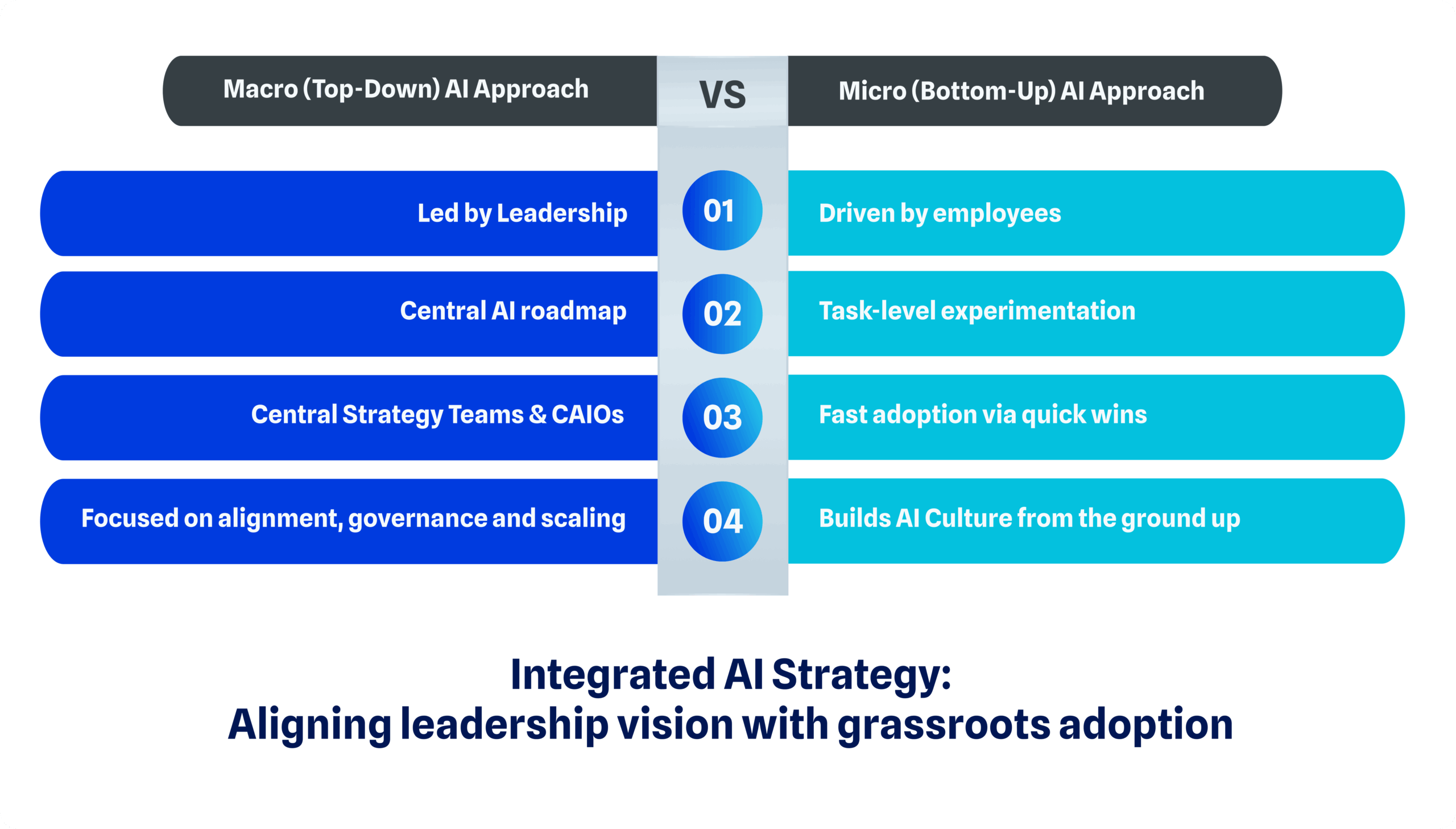
The macro approach treats AI as a strategic transformation program. Boards and CEOs are educated on AI opportunities and risks, set policies, and mandate organization-wide AI projects. For example, training programs like the AI Leadership Forum for board directors focus on integrating AI into core strategy and risk oversight . Many large enterprises in 2024–2025 have followed advice to appoint a Chief AI Officer (CAIO) and define a centralized AI roadmap . “We are seeing companies making investments in chief AI officers to help steer AI strategy… ensuring an empowered leader can make strategic decisions,” notes Dell Technologies, which advocates a top-down model for AI implementation . The perceived benefit of this approach is clarity and control – aligning AI with business objectives, avoiding duplicated efforts, and managing risks like ethics and compliance in a uniform way.
However, exclusively top-down efforts have notable drawbacks. A mandate from on high does not guarantee enthusiasm or adoption on the front lines. In fact, cultural resistance and emotional friction are often the biggest blockers to AI’s impact, rather than technical issues . Employees may view a corporate AI rollout as an imposed change they don’t understand or even fear – especially if messaging centers on productivity gains and cost-cutting. Boston Consulting Group observes that companies can end up with “AI… technically deployed but culturally refused” – an “organ rejection” effect where workers reject AI tools that they feel were foisted on them without regard for their needs or concerns . This dynamic can stall even well-funded AI programs. As one BCG expert put it, “If people aren’t adopting AI, you’re not getting any impact” . Notably, research finds that 70% of software developers weren’t using generative AI tools in 2023 despite their availability – a reminder that simply rolling out technology from above doesn’t ensure usage.
By contrast, the micro approach begins with the people closest to the work. It asks: how can AI help this person in this task today? Rather than waiting for a central committee to deliver AI solutions, employees are empowered (through training and tools) to experiment and improve their own workflows. This bottom-up philosophy is gaining traction as companies realize that AI’s real value emerges from widespread adoption in daily activities, not just a few big flagship projects. Francine Katsoudas, Cisco’s Chief People Officer, observed that while companies initially took a top-down view, “what seems to be emerging at some organizations is the importance of power users – people showing use cases on the day-to-day level and showing others how AI makes their jobs easier.” In other words, grassroots AI innovators can spark a broader movement within the firm.

The micro approach emphasizes experimentation, agility, and quick wins. Every employee is encouraged to identify opportunities where AI could eliminate drudgery or enhance output . Instead of “AI in search of a problem” – a criticism of some top-down initiatives – it becomes problems and ideas sourced directly from the business units. “Far better is a bottom-up approach, empowering teams to identify what they need, then providing licenses and training,” argues AI researcher Henry Shevlin, contrasting it with the mistake of top-down managers picking tools and pushing them onto teams . When employees drive the process, AI solutions tend to target practical pain points and thus see faster uptake. One Medium study notes that this method can “significantly boost efficiency, productivity, and quality, resulting in a compounding effect on top-line and bottom-line results.” In short, lots of small improvements across the workforce can add up to transformative gains.
Crucially, a bottom-up approach also begins to build a pro-AI culture. Early adopters become internal champions who help peers learn, and successful experiments serve as proof-of-concepts that reduce skepticism. This fosters an environment where AI is viewed not as a threat or edict, but as a helpful enabler that employees themselves chose to leverage. As we will explore, this dramatically improves buy-in and diminishes the fear factor.
The remainder of this paper examines these two approaches in depth and illustrates why focusing only on the macro level is insufficient. We advocate for an integrated strategy in which leadership-driven and employee-driven AI initiatives reinforce each other. First, we delve into the benefits and limitations of the traditional top-down approach. Then we highlight the power of micro-level AI adoption with examples of success. We also draw lessons from historical technology adoptions that combined top-down direction with bottom-up innovation. Finally, we propose a practical framework (and outline Bold Business’s “AI-Amplified Talent” methodology) to marry the macro and micro approaches for optimal results.
The Macro (Top-Down) AI Strategy – Vision with Vital Oversight
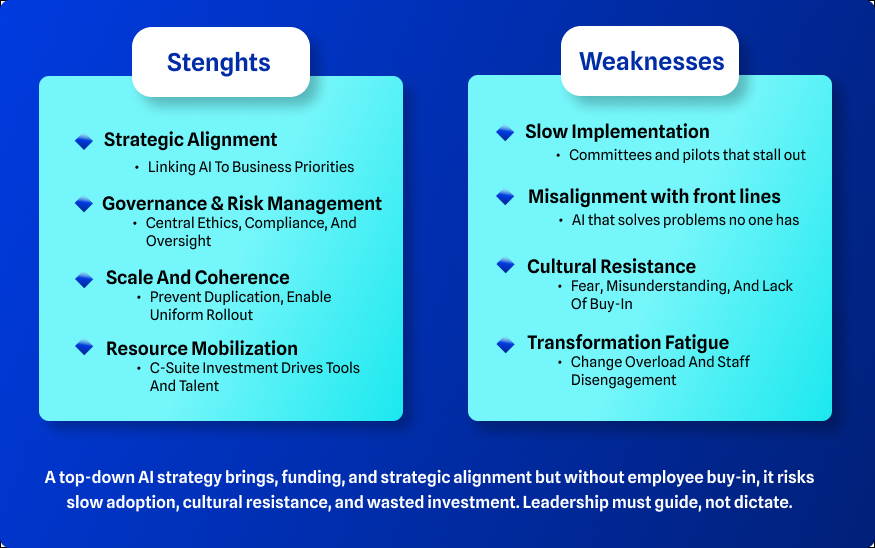
A macro-level AI implementation typically starts with executive intent. Leadership recognizes AI as a strategic priority and deliberately plans how to infuse AI into the organization’s processes, products, and decisions. This top-down approach comes with several advantages:
- Strategic Alignment: By developing an AI strategy at the C-suite or board level, organizations ensure AI initiatives directly support the overall business strategy. Resources can be focused on high-impact areas (e.g. improving customer experience, optimizing supply chain) rather than scattered experiments. A top-down mandate also often means dedicated budget and talent for AI projects. Indeed, one in three companies now invests over $25 million in AI, reflecting leadership’s commitment.
- Governance and Risk Management: AI raises legitimate concerns – from biases in algorithms to data privacy to regulatory compliance. A centralized approach allows the company to establish governance frameworks, ethics guidelines, and security protocols from the outset. Many boards are creating AI oversight committees to supervise these aspects. For example, Chief AI Officer roles are emerging to set standards and prevent rogue AI projects . “Organizational strategy and having an empowered leader… is the really big active conversation right now,” notes Dell’s Global CTO, stressing that structuring AI efforts top-down is key to success.
- Scale and Coherence: The macro approach aims to scale AI uniformly across the enterprise. Rather than isolated use cases, the goal is to integrate AI “at scale” in core operations. This can prevent duplication (multiple teams solving the same problem with AI) and concentrate efforts on enterprise-wide platforms (for instance, a common machine learning infrastructure or generative AI service that everyone can use). Peter Marrs, President of Dell APJ, observed that without a clear strategy, companies end up with “project overload” – dozens or hundreds of AI pilots with no coherence . A top-down model, with a central leader or committee, can triage and coordinate projects so that the most promising ones get the investment and support to scale up.
- Resource Mobilization: When the CEO and board are driving AI, it sends a strong message through the organization. This often accelerates talent acquisition (hiring data scientists, AI engineers) and technology investments (tools, cloud infrastructure) necessary for AI. It also encourages business units to prioritize AI projects because they know top management is watching. In fact, Boston Consulting Group finds that CEO involvement is pivotal: “AI only delivers impact when employees embrace it… and that only happens when the CEO leads the charge” . CEO sponsorship can legitimize AI initiatives and break down inter-departmental barriers that often hinder innovation.
Despite these benefits, the macro approach alone has significant limitations. As noted earlier, the people factor can make or break AI adoption. A purely top-down program may falter if it doesn’t win hearts and minds at the grassroots. Several challenges inherent to macro implementations include:
- Slow, Siloed Implementation: Big programs and committees tend to move slowly. Extensive studies, high-level task forces, and cross-functional alignment meetings can delay actual AI deployments. By the time a centralized team delivers a solution, the business need may have shifted or the technology may be outdated. Additionally, if pilots are run in silos (e.g. one per department) without a mechanism for sharing lessons, “promising pilots wither before delivering results” . BCG notes that only about 25% of businesses have managed to scale AI beyond pilots – many get stuck in a perpetual pilot purgatory due to fragmented top-down efforts.
- Misaligned with Front-Line Needs: A central AI committee might identify use cases that look good on paper but don’t address pressing pain points for employees. There is a risk of “technology looking for a problem” – deploying AI for the sake of AI. Without ground-level input, implementations can miss critical requirements or user experience factors that determine success. For instance, a retail chain’s leadership might mandate an AI inventory optimization system, but if store managers aren’t involved, the solution might be impractical on the floor and face resistance . Different views at the top versus the ground reality can derail adoption if not reconciled.
- Cultural Resistance and Fear: Perhaps the biggest issue is human psychology. Employees often fear that top-driven AI initiatives are aimed at replacing them or will impose new tools without adequate training . When leadership “pushes AI without context, employees assume they’re being replaced”, leading to fear and pushback . A Kearney analysis emphasizes that employees must be at the center of AI adoption to overcome fear of the unknown . If the workforce feels AI is something being done to them (a productivity mandate from above) rather than forthem, they may disengage or even subvert the effort. A telling statistic from a 2024 Slack survey: 48% of workers said they would be uncomfortable admitting to their manager that they used AI for help on a task . This stems from fear of being seen as lazy or less competent. Such stigma can thrive in environments where AI use isn’t normalized and encouraged from the bottom up.
- “Transformation Fatigue”: Large-scale programs often come with change management campaigns, training sessions, and new guidelines that can overwhelm staff. If every process suddenly has an “AI initiative” attached, employees may feel change fatigue or skepticism (“here comes another corporate program of the year”). This can ironically dampen the curiosity and creativity that AI adoption needs.
In summary, a macro approach provides vision, structure, and safeguards – all necessary ingredients, especially to avoid chaos in big organizations. However, it must be coupled with genuine engagement at the micro level to succeed. Top-down leadership should be the enabler, not the sole driver. As we explore next, unlocking the energy and ideas of the broader workforce – the micro approach – is the catalyst that turns AI from a boardroom agenda item into an everyday productivity tool embraced by all.
The Micro (Bottom-Up) Approach – Empowering the Front Lines with AI
A micro-level approach to AI flips the focus to the individual employee and team. Instead of asking “what grand AI project should we implement enterprise-wide?”, it asks “what AI assistance would make your job easier or your team more effective today?” It is essentially a people-first, use-case-first strategy. This approach nurtures AI adoption organically by seeding many small-scale experiments and letting the most valuable ones grow.
Key characteristics and benefits of the micro approach include:
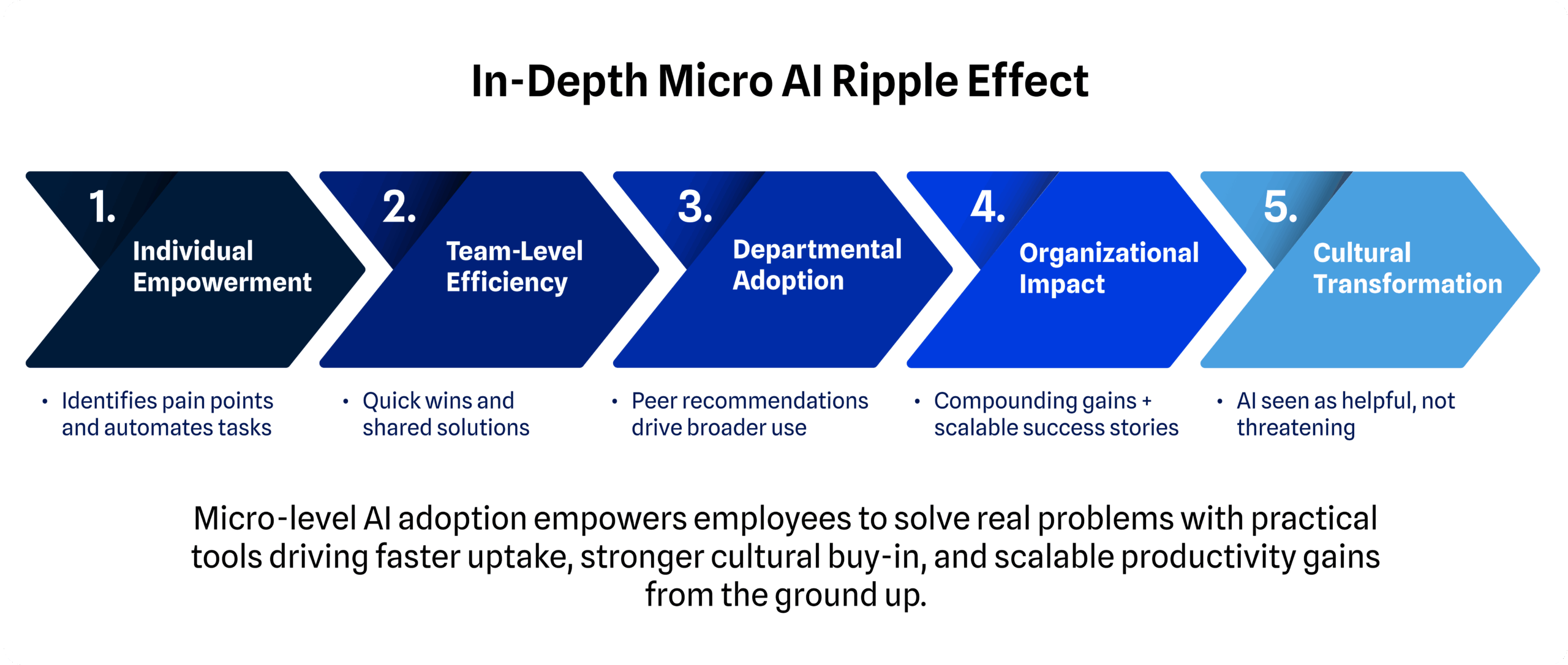
- Grassroots Innovation: Every employee is encouraged to be an innovator, identifying tasks or problems in their workflow that AI could help with. This might be as simple as using a generative AI assistant to draft routine emails, or as complex as a data analyst building a machine learning model to automate part of a process. The critical point is that ideas come from the bottom up. According to Ruban Phukan, an AI entrepreneur, empowering employees at the operational level unlocks a massive opportunity: “every employee [can] identify areas in their daily work that can benefit from AI… significantly boosting efficiency, productivity, and quality” . Workers on the ground often know their pain points best, so they are well positioned to envision AI solutions that leadership might never consider.
- Quick Wins and Proof of Value: Bottom-up AI tends to emphasize small experiments and rapid prototyping. Cross-functional teams or individuals can conduct quick proofs-of-concept on a much shorter cycle than enterprise projects. Many organizations adopting this approach report early wins: e.g., a manufacturing team that built a simple AI tool for predictive maintenance, which “led to a full-scale rollout after initial success in reducing equipment downtime” . These wins are crucial for building momentum. They demonstrate tangible benefits to both employees and managers, justifying further investment. In contrast to long macro projects that might take a year to show results, micro-projects can yield improvements in weeks or months. This iterative learning-by-doing fosters a culture of continuous improvement.
- Higher Adoption Rates: When employees create or choose the AI tools themselves, they are naturally more inclined to use them. The solutions are tailored to their context (since they had a hand in it), and there is a sense of ownership. Moreover, coworkers trust recommendations from peers. For example, in one company a few Sales Development Representatives (SDRs) started using an AI agent to automate lead research and outreach; when their productivity jumped, others on the sales floor quickly wanted to adopt the same tool . Such peer-driven adoption can outpace any top-down mandate. Employees embrace AI when they see it solves their problems – and stories of colleagues’ successes provide credible proof. BCG researchers similarly found that “when a co-created project begins to show impact… project members return to their teams and share what they’ve learned, helping AI take root across the organization” . Essentially, early adopters become evangelists.
- Cultural Buy-In and Reduced Fear: The micro approach inherently treats AI as a helpmate for employees, not a threat. Because it is bottom-up, it flips the narrative – AI isn’t something the boss is imposing; it’s something Iam using to make my own work better. This can significantly reduce fear and resistance. Deborah Lovich of BCG cautions that if leaders only frame AI as a productivity tool, employees hear “we just want you to work faster,” which discourages engagement . But when employees themselves discover that an AI tool “reduces toil in their daily work” , their mindset shifts to seeing AI as positive. Indeed, in one pilot BCG ran, participants who got an AI scheduling assistant reported the task became more enjoyable (79% of people) and more effective (86%), with 92% saying they would continue using the AI tool after the pilot . This illustrates how personal experience with a helpful AI solution builds enthusiasm rather than fear. It’s a bottom-up win: workers felt “AI made my job better,”which is far more convincing than being told in a training session that AI is great.
- Compounding Productivity Gains: Bottom-up AI can unlock innumerable efficiency improvements that aggregate to significant business impact. An internal study by one AI tools provider found the average employee spends ~28 hours a week on routine tasks that don’t add much value . Multiply that across hundreds or thousands of staff, and the opportunity cost is huge – tens of millions of dollars in wasted effort. By empowering each worker to streamline or automate such tasks (e.g. through AI agents or smart assistants), companies can reclaim that time. The GoodGist blog calculates that for a 1000-person organization, saving those wasted hours could be worth over $67 million a year . While a top-down program might target one area for efficiency, a bottom-up approach can attack inefficiencies everywhere, driven by those who know the work intimately. It’s the principle of aggregation of marginal gains – many 5% or 10% productivity boosts across various roles can dramatically improve an organization’s overall performance.
- Skilling Up the Workforce: In the process of bottom-up experimentation, employees naturally increase their own AI literacy and skills. They learn by doing – whether it’s prompt engineering for a generative AI, building a simple chatbot, or interpreting AI-driven insights. This addresses a major adoption barrier: lack of skills and confidence. Surveys indicate only about 40% of companies provide formal AI training to employees , so most workers currently “don’t know what to do” if asked to use AI for efficiency . Bottom-up initiatives, especially when supported by some training resources, fill this gap by creating a hands-on learning environment. Cisco’s Francine Katsoudas shared a telling example: Cisco launched an optional pilot where employees could get training (a “Green Belt” certification in AI skills) and then were asked to apply AI in their day job and report the results . She hoped 300 employees would volunteer; nearly 800 signed up, generating 282 new AI use-case ideas and measurable productivity improvements . Equally important, participants’ “confidence and comfort in the technology” climbed markedly . This bottom-up skilling approach indicates people are eager to learn AI when it’s directly relevant to their work and when they have permission to experiment.
It’s worth noting that the micro approach does not mean chaos or a complete lack of coordination. It can be structured through programs like innovation challenges, “citizen developer” communities, or internal hackathons to surface and support the best ideas. The difference is the locus of initiative: ideas and prototypes originate with the people who will also use them. Some companies have adopted a two-pronged model to balance freedom and focus. For instance, the Chief AI Officer of Globe Telecom describes their approach: “Internal productivity and whatever else [employees] desire – purely bottoms-up. All teams are empowered and given the tools to create and build. Meanwhile, our internal AI product and engineering team handles top-down requirements from strategic imperatives… We run programs to amplify citizen development and keep it flourishing.” In other words, they encourage broad experimentation (bottom-up) alongside a guided core of strategic projects (top-down). This kind of model ensures that the bottom-up efforts align with company goals and that successful grassroots projects can be elevated and scaled.
In summary, micro-level AI adoption taps into the creativity and agency of the entire workforce. It positions AI as a personal tool for empowerment rather than a corporate directive. By doing so, it creates pull from below – employees want to use AI because they see direct benefits – rather than relying solely on push from above. The result is typically faster adoption, richer use-case discovery, and a more resilient pro-AI culture. However, the micro approach on its own is not a panacea; it works best when guided by an overarching framework and support from leadership. We next examine how to integrate these approaches, leveraging the strengths of both.
Bridging the Two Worlds: A Framework for Macro-Micro Synergy
Rather than viewing macro and micro approaches as an either/or choice, leading organizations are realizing that the real key is integrating the two. A successful AI transformation requires top-down vision and guardrails alongside bottom-up engagement and innovation. How can companies structure this in practice? This section outlines a framework wherein macro and micro initiatives complement each other at each stage of the AI adoption journey.
- Leadership Sets the Tone and Purpose (Macro) – The journey begins with executives articulating a clear, positive vision for AI that aligns with the company’s mission. Crucially, this vision should emphasize how AI will benefit employees, customers, and the business alike. For example, instead of merely saying “AI will drive efficiency,” a forward-looking CEO frames it as “AI will be used to make your work more enjoyable and meaningful by automating the drudgery” . Setting this tone is vital to pre-empt fear. Leaders must communicate that AI is here to augment, not replace– echoing the adage that “AI won’t replace people, but people who know how to use AI will replace those who don’t” . This kind of message, backed by commitment from the top, establishes psychological safety for employees to start exploring AI. It also signals that the company is serious about investing in AI (so employees should pay attention), but serious about responsible use as well.
- Establish Guardrails and Support (Macro) – As employees begin experimenting, they need a supportive structure. The organization should provide guidance on ethical and effective AI use. This includes policies (e.g. what data can/can’t be used with external AI tools, addressing IP or privacy concerns) and training resources for AI literacy. It’s here the top-down role is one of an enabler and protector. For instance, Cisco recognized that while bottoms-up innovation was crucial, they also needed “a responsible AI framework so that people know what’s appropriate and how to leverage data” . Similarly, macro-level investment in enterprise AI platforms (like a vetted internal generative AI assistant) can give employees safe, company-approved tools to play with. The idea is to make the default path to experiment with AI easy and safe. Leadership can also allocate funding or “innovation time” for AI side projects, sending a message that using some work hours to tinker with AI is not just allowed but encouraged.
- Empower Champions and Communities (Micro) – Identify tech-savvy or enthusiastic employees in various departments who can act as AI champions. These people can be given extra training and then tasked to support their peers. BCG calls them “AI adoption champions” and suggests picking “your best people who are looked up to by their peers”, because they will effectively bridge the gap between leadership’s vision and day-to-day practice . An AI champion might run a demo session for their team showing how they used AI in a sales call or coding task, for example. In parallel, foster communities of practice where employees share AI tips and successes. Many companies have created internal forums or chat groups for AI ideas. The goal is to make AI adoption a social, collaborative effort rather than a solitary or secretive one. When employees hear success stories from colleagues (in their own language, addressing their specific job context), it builds credibility and excitement that no top-down communication can match.
- Co-Create Solutions and Pilot (Micro + Macro) – When promising bottom-up ideas emerge, the organization should support them through a co-creation process. This is where macro meets micro. Suppose an employee in finance comes up with an idea to use AI to reconcile accounting entries faster. Rather than that idea remaining a local hack, the central AI/data team can partner with that employee to formally pilot the solution. By cocreating AI projects with involvement from end-users, companies ensure the solution actually fits the need and that the end-users feel ownership. “Designing for adoption at scale holds co-creation as a guiding principle,” writes Lovich of BCG . In practice, this might mean establishing cross-functional pilot teams that include both technical experts and the front-line employees who identified or will use the AI solution. When these pilots succeed, the employees involved become natural ambassadors: “The employees who were part of the AI pilot will advocate for the transformation, act as internal influencers and coaches, and lead by example” .
- Scale What Works (Macro) – Not every bottom-up experiment will pan out, and that’s okay. But some will show clear evidence of value (e.g. a 10x productivity gain for a specific task). Leadership’s role is to recognize these wins and pour fuel on the fire. This could mean investing to turn a prototype into a fully supported tool, integrating an AI solution into mainstream IT systems, or simply publicizing and rewarding the team that did it. Scaling also involves standardizing successful approaches across business units. For instance, if one marketing team uses an AI tool to generate campaign content 5x faster, the CMO can roll those practices out to all marketing teams. Here the top-down structure helps in diffusing innovation organization-wide. It’s a reversal of the typical sequence: instead of a top strategy pushing down, a bottom innovation percolates up and then is spread across by management.
- Feedback Loop and Continuous Learning – An integrated macro-micro approach is not a one-off program but an evolving journey. Leaders should continuously gather feedback from the workforce: what’s working, what barriers exist, what new ideas are bubbling up? This can be done through regular pulse surveys or town halls focused on AI usage. Likewise, metrics from AI tool usage can be monitored. Using those insights, the central strategy can be updated. Perhaps certain departments need more support or training; maybe a successful approach in one region can be localized elsewhere. Flexibility is key – the macro strategy should adapt based on micro-level learnings. Over time, as more employees become proficient with AI, the organization can set more ambitious goals (e.g. moving from using AI for efficiency to using AI for new revenue-generating products). The culture of bottom-up innovation, once established, becomes a self-reinforcing engine that drives further AI maturity.
To visualize how these layers interact, consider the following simplified comparison and interplay:
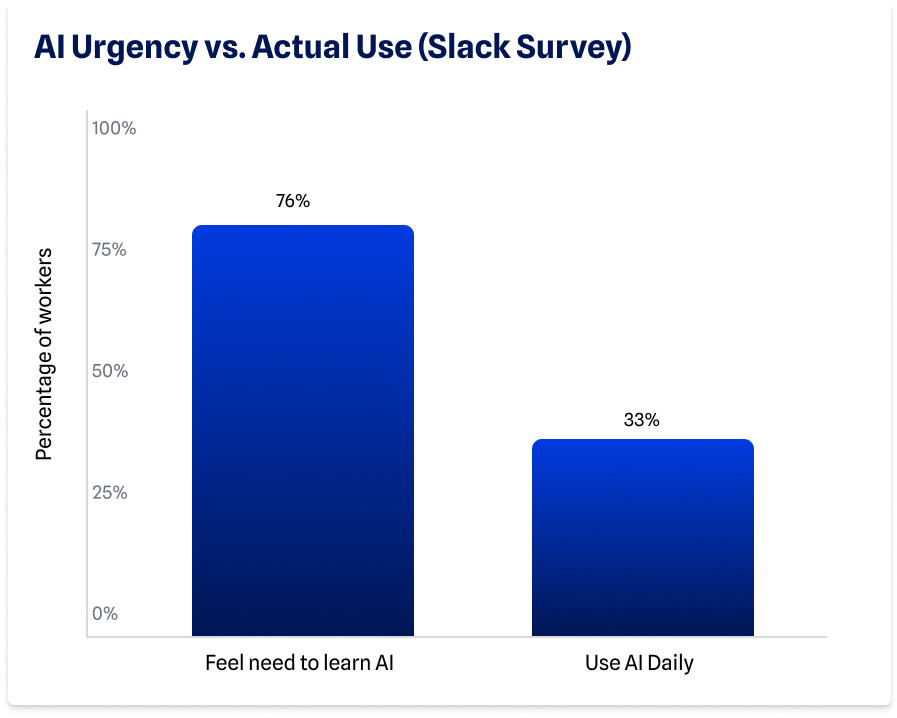
Figure 1: Gap between AI urgency and actual usage among employees (Slack survey). 76% feel the urgency to become AI-savvy, but only 33% use AI in daily work . Bridging this gap requires top-down support (to train and encourage) and bottom-up initiative (to apply AI in everyday tasks).
- Macro (Top-Down) Focus: Company-wide AI vision; Governance & ethical guidelines; Strategic AI projects (major use cases); AI infrastructure & tools provisioned; Leadership communication & role-modeling AI use.
- Micro (Bottom-Up) Focus: Individual use cases & ideas; Daily workflow improvements; Peer-to-peer learning and local experiments; Feedback on tool effectiveness; Grassroots champions demonstrating value.
Think of the macro approach as providing the north star and the guardrails, and the micro approach as propelling the cars forward on the road. Without leadership’s north star, individual efforts might veer off-track or stall due to obstacles. But without the grassroots engine, the convoy moves too slowly or not at all. The most competitive organizations are those that harness both. As Cisco’s Katsoudas put it, “We believe strongly in the bottoms up… You need to have that to innovate and to be inclusive… Let the people closest to the work guide how [AI] is leveraged moving forward” – with the caveat that leadership provides the framework and support.
In practice, companies may start at different points on this spectrum. Some traditionally top-down cultures will need to intentionally spur more bottom-up activity (perhaps by launching an “AI ideas” program or citizen developer initiative). Others that already have lots of grassroots tech experimentation might need to formalize oversight (for example, IT establishing an approval process for deploying new AI tools to ensure security/compliance). The balance will vary, but the principle remains: neither approach should exist in a vacuum. The next section offers a brief historical perspective illustrating how combining top-down and bottom-up elements has been key in previous technology adoptions.
Historical Insight: Mainframes to PCs – A Lesson in Bottom-Up Change

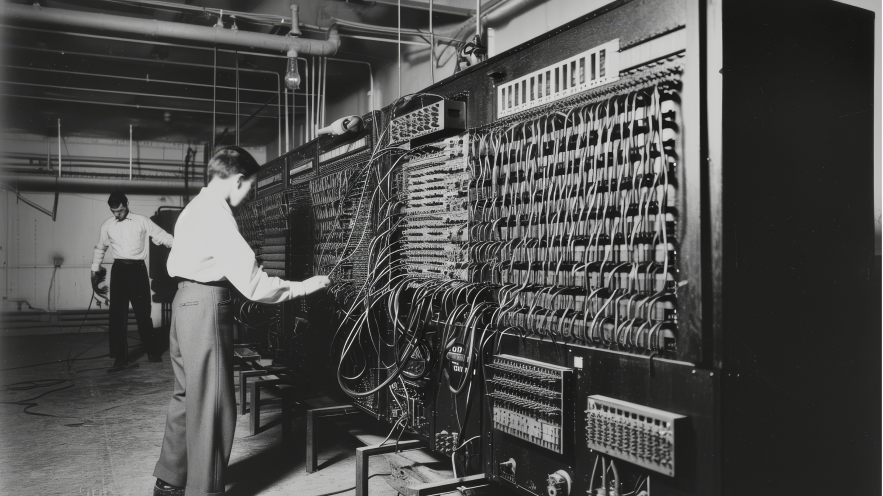
History offers a powerful analogy for the current AI adoption challenge: the shift from centralized mainframe computing to personal computers in the 1980s. In the mainframe era, computing power was strictly a top-down resource – controlled by IT departments, and users had to submit requests for reports or computations. Early efforts to modernize businesses with computers were very macro-driven. Yet, the true revolution in business productivity came when computing power was democratized into the hands of individuals via PCs and software like spreadsheets. This transformation shows the interplay of macro and micro forces.
In the 1970s, if a finance employee needed to analyze data, they often had to ask the data processing center to run a batch job on a mainframe, then wait days for a printed report . Access to computing was limited and tightly controlled – analogous to how advanced analytics and AI were until recently confined to specialists. The introduction of the electronic spreadsheet (VisiCalc in 1979, Lotus 1-2-3 in 1983) changed everything. For the first time, analysts and accountants could perform complex calculations themselves on a desktop computer interactively. “Spreadsheet software was the application that most helped justify corporate deployment of PCs in huge numbers during the 1980s,” one retrospective notes . Millions of copies of these tools were sold, “putting fairly sophisticated modeling tools into the hands of people who a few years earlier probably had no idea what a spreadsheet was.”
This was a bottom-up surge. Individual employees adopted PC spreadsheets to solve day-to-day tasks like budgeting, forecasting, and reporting – tasks that previously were tedious or required central IT. As they did, they proved the value of PCs. In fact, employees’ enthusiasm for tools like VisiCalc and Lotus 1-2-3 forced many companies to invest in PCs and loosen the reins of central IT. IBM’s own PC business took off because business users demanded personal computing on their desks. As eWEEK recounts, “the first PC spreadsheet to catch on was VisiCalc… selling hundreds of thousands of copies and helping to open corporate office doors to rapid PC adoption.” The bottom-up adoption of PCs by end-users ultimately drove the top-down decision in companies to shift away from mainframes for many applications.
Of course, leadership still played a role: forward-thinking managers recognized the boost in productivity and began officially supporting PC use, providing training, and integrating PC data into enterprise workflows. But the impetus and proof came from the ground. Interestingly, the PC revolution also came with fear and resistance at first – much like AI today. There were concerns that spreadsheets would make traditional accountants obsolete. One anecdote recalls that “in the 1980s, when Microsoft released Excel, people were petrified and said it would put accountants out of a job.” . What happened instead? Accountants who learned to use spreadsheets became more valuable and efficient, and those stuck in old ways had to catch up. In a similar vein, IBM’s data and AI leader Rob Thomas recently noted: “while it’s unlikely AI will replace people any time soon, people that know how to wield AI will replace people that don’t.” . The lesson from the spreadsheet era is that empowering people with new technology can dramatically improve work, but there is a period of adjustment where skills and mindsets must change.
The introduction of PCs also required a new macro-micro equilibrium. Eventually, companies established PC standards, policies (what software was approved, etc.), and provided training – a macro structure – after they saw the micro-level benefits emerging. We see a parallel today: employees are bringing AI tools (like ChatGPT or no-code AI platforms) into their own work on a small scale, often before official IT approval. Forward-looking firms will acknowledge this bottom-up energy and then provide the top-down support to harness it securely. Those that do will leap ahead, much as firms that embraced PCs early gained a competitive edge in the 1980s.
In summary, the history of PCs vs. mainframes underscores the power of user-driven tech adoption. Top-down strategies that ignored the PC trend were left behind, and bottom-up PC use without any corporate oversight led to “shadow IT” messes. The winners combined the two – encouraging PC use where it made sense and establishing company-wide support once it was clear it delivered value. Today’s AI adoption should follow a similar playbook.
Not long ago, using personal technology at work was considered radical – IT departments actively tried to stop employees from using their own devices or apps on the job . This began to change after the 2007 launch of the iPhone, when staff discovered their new smartphones could boost their efficiency at work as well as at home . Bring Your Own Device (BYOD) quickly became a bottom-up phenomenon – a “reversed IT adoption” driven by employees rather than managers . Apple’s introduction of enterprise device management features in 2010 finally gave IT a way to secure personal devices, and nearly overnight companies started allowing BYOD across industries.
Early on, many corporate leaders were skeptical and resistant. Security was a top concern – about 30% of IT leaders cited data security as the biggest obstacle to BYOD adoption . Indeed, the idea was initially rejected in many firms due to security fears , and most organizations encountered pushback around allowing personal phones on the network (only 14% of companies saw no resistance during BYOD adoption) . In practice, however, employees pressed ahead. Surveys showed that even in conservative environments, a majority of staff were bringing their own phones or tablets to work despite the rules . Forward-looking companies like Cisco quickly realized BYOD’s potential – by 2012 Cisco’s internal BYOD program had exploded, with employees using over 20,000 iPhones and 8,000 iPads on the corporate network . Faced with this grassroots demand, IT departments had to adapt or risk being bypassed by their own users.
Over the next decade, BYOD went from fringe to fully mainstream. Today more than 80% of organizations allow BYOD in some form , and programs to manage employee-owned devices are standard. Studies find that letting staff use familiar personal devices can boost productivity – 68% of companies report measurable productivity gains from BYOD policies . Employees are often more comfortable and efficient on their own phones or laptops, and they appreciate the flexibility of carrying a single device for both work and personal life. Companies have benefited too, saving on hardware costs (on the order of hundreds of dollars per employee each year) and seeing happier, more mobile workforces .In short, the BYOD movement – sparked from the bottom up by individual users – fundamentally transformed corporate IT. What began as leaders scoffing at “consumer toys” evolved into an accepted norm, once the productivity gains and employee satisfaction won the day and forced policy changes.
Generative AI (ChatGPT): The Next Bottom-Up Wave

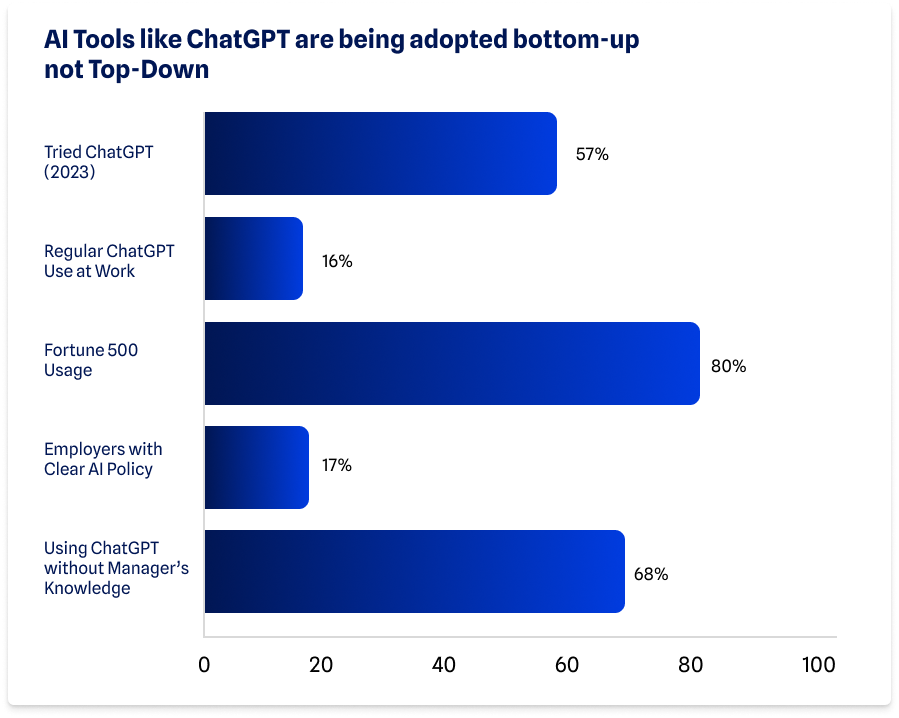
Another bottom-up transformation is now emerging with the rise of AI chatbots like ChatGPT. Introduced to the public in late 2022, ChatGPT reached 100 million users within months , driven almost entirely by individual adoption. Employees across industries started experimenting with it for work tasks – drafting emails, brainstorming ideas, writing code, researching, and more . By mid-2023, 57% of American workers had already tried ChatGPT and about 16% were using it regularly at work . This explosion in usage has largely been unsanctioned and grassroots. In fact, ChatGPT’s use has “permeated numerous workplaces, including 80% of Fortune 500 companies,” even though most leadership teams have provided little to no guidance on it . Only 17% of workers say their employer has a clear policy on AI use – and those policies are split between encouraging and outright prohibiting the tool . The situation closely resembles the early BYOD era: employees are embracing a powerful new technology on their own, while managers scramble to catch up.
Corporate resistance and fears have surfaced quickly. Companies worry about data leaks, inaccuracies, and compliance risks from AI. In one high-profile incident, Samsung engineers input confidential source code into ChatGPT to help debug – the data was later found in the model’s responses, prompting Samsung to ban ChatGPT entirely for a time . Numerous firms (especially in finance and government) initially blocked access to public AI tools out of caution. Yet these top-down bans have been only partly effective, because employees often find workarounds. A 2025 survey in France found 68% of employees using ChatGPT at work have not informed their management . In other words, much like the early days of BYOD, staff are adopting the tech informally and under the radar – a classic hallmark of bottom-up change. They do so because generative AI offers tangible productivity benefits, from automating routine writing to providing quick research and coding assistance. Many workers feel tools like ChatGPT help them “work smarter, not harder,” augmenting their output rather than replacing them . Forward-thinking organizations are now beginning to respond, formulating AI usage policies and exploring privacy-safe versions of these tools (such as enterprise-grade AI platforms) to harness the upside while managing the risks. But it’s clear that the pull is coming from employees who see AI as the next essential tool – very much how they viewed personal smartphones a decade earlier.
Parallels Between the BYOD and AI Revolutions

Both the BYOD movement and the current wave of generative AI adoption showcase a “bottom-up” theory of change in corporate tech. In each case, individual users drove transformation long before top management fully bought in. The similarities are striking:
- Grassroots Adoption: In both trends, employees began using the technology on their own initiative – personal devices in the case of BYOD, and AI chatbots in the case of ChatGPT. This consumer-driven uptake forced organizations to react, rather than the change being mandated from the top.
- Initial Leadership Skepticism: Both innovations faced early resistance by corporate leaders and IT. Smartphones were seen as security risks or mere gadgets at first, and likewise many bosses viewed AI tools with suspicion (worried about data security or job impacts) . In fact, the majority of organizations initially reported pushback to BYOD and many have similarly restricted ChatGPT usage at work.
- Employee Productivity Pull: Despite skepticism, adoption continued because workers found these tools immensely productive. Using familiar personal phones made employees more efficient and satisfied (gaining up to an hour of productivity per day) . Similarly, those using ChatGPT report it helps them accomplish tasks faster and brainstorm ideas, improving work output (e.g. speeding up writing and coding) . This practical value to end-users created bottom-up pressure that leadership could not ignore.
- Eventual Company Integration: Over time, what started as shadow IT became standard IT. Companies that once banned personal devices eventually developed BYOD policies and invested in mobile device management to securely support them . We are now seeing a parallel with AI – organizations are beginning to draft formal guidelines and consider approved AI platforms so employees can leverage tools like ChatGPT safely rather than via workarounds . In both cases, management had to adapt to the reality that the technology was here to stay.
In summary, the BYOD revolution and the rise of generative AI in the workplace are two major transformations propelled from the ground up. They prove the power of bottom-up adoption: if a technology genuinely boosts individual effectiveness and is easy to access, employees will embrace it – and ultimately corporate leaders will come around. What starts as a grassroots trend can rapidly become standard operating procedure, reshaping company culture and policy once the benefits become impossible to dismiss . The widespread personal adoption of AI today appears poised to follow the successful bottom-up pattern set by BYOD, potentially ushering in the next big leap in workplace productivity and innovation.
Bold’s “AI-Amplified Talent” Approach: Jump-Starting Micro Successes
Bold Business recognizes that for AI to truly take root in an organization, individual employees need to experience its benefits firsthand. Bold’s service offerings around “AI-Amplified Talent” are built on this principle. Rather than only delivering high-level AI strategy reports, Bold focuses on empowering the client’s people with AI tools quickly, to spark that grassroots adoption cycle.
One flagship program is the Bold AI QuickStart. In a QuickStart engagement, Bold works with a client to identify a handful of specific, impactful use cases at the employee or team level – essentially micro-projects that can be completed in a short time frame (days or weeks). These might be pain points like automating a repetitive data entry task, creating an AI-driven FAQ assistant for customer support agents, or generating first drafts of marketing content using GPT. Bold’s experts then build or configure AI solutions (or even just craft effective AI prompts) for those targeted problems, and embed them into the employees’ daily workflow. The result is that within a very short time, employees start to feel the productivity lift or quality improvement from AI.
This hands-on approach serves multiple purposes:
- Demonstration of Value: It produces concrete examples inside the company of “AI making my job easier.” Skeptical employees often turn into AI advocates once they have a tool that, say, saves them 2 hours a day on routine paperwork. These quick successes create internal case studies and success stories that can be shared across the organization, building demand for more AI. It’s not abstract talk – it’s Joe in finance showing how an AI script reconciled reports in 5 minutes instead of an hour.
- Reducing Fear Through Experience: By working side-by-side with employees on their first AI use cases, Bold helps demystify AI. The employee is part of creating the solution (or at least customizing it), so they gain familiarity and confidence. The fear of “AI” being a job killer is replaced by an understanding that AI is a tool they control. Bold essentially acts as a coach, providing curated prompts and guidance, so that the experience is positive and not frustrating. For example, an employee might be intimidated by ChatGPT at first, but with Bold providing a tailored prompt playbook for their role, they quickly see useful results and lose the hesitation.
- Cultural Signal: When a company brings in AI assistance not just at the C-suite level but to assist frontline staff, it sends a powerful message: we are investing in you, the employees, to get the most out of AI. This can significantly boost morale and openness. It positions the narrative as augmenting talent (hence “AI-Amplified Talent”) rather than replacing it. Each person augmented by AI becomes a testament that AI + human can achieve more. Over time, this helps shift the culture to one of collaboration with AI.
- Framework for Scaling: The QuickStart projects are deliberately chosen to be replicable and scalable. Bold doesn’t just build a one-off tool and disappear; the approach includes establishing a template or process that the client can extend. For instance, if Bold helps create a prompt-based report generator for one team, that same approach can be adapted by other teams for their reports. Bold often provides training to a set of client “AI champions” during the project, so that they can carry the torch forward. In essence, Bold seeds the micro-level successes and equips internal champions to propagate them (tying back to the earlier framework of empowering champions).
By kick-starting the micro wins within the structure of an engagement, Bold helps organizations overcome the initial inertia or uncertainty in their AI journey. Many companies conceptually understand AI’s importance but get stuck in analysis paralysis or high-level planning. Bold’s approach is to break that logjam by doing – rapidly prototyping solutions with employees. This generates the dual momentum of leadership seeing quick ROI and employees feeling excited about AI in their own jobs.
Of course, Bold also advises on the macro elements (e.g. suggesting governance policies, aligning projects with strategy), but the distinguishing factor is this accelerated bottoms-up impact. It’s somewhat analogous to an “innovation catalyst” role – sparking a flame at the micro level that the organization can then fan into a larger fire. Bold’s experience has been that after a QuickStart, clients often find that what started as a small prompt or tool grows into a broader application adopted company-wide, and employees begin coming up with their own ideas for the next AI improvements. This is the ideal outcome: the organization reaches a tipping point where AI adoption becomes self-driven by the workforce, supported by management.
In summary, Bold Business’s AI-Amplified Talent philosophy embodies the core thesis of this paper: AI has to win hearts and minds on the ground, not just be mandated from the boardroom. By rapidly empowering individuals with AI capabilities and focusing on human-centric benefits, Bold accelerates the cultural shift and skill development that make an AI initiative truly stick.
Conclusion: Unleashing AI’s Full Potential – One Person at a Time

Enterprise AI success isn’t achieved solely by grand strategies, nor by isolated tinkering – it emerges from the synthesis of structured vision and widespread participation. Organizations that complement a top-down AI strategy with a bottom-up adoption culture will be the ones to fully realize AI’s promise. The macro approach provides essential ingredients: leadership commitment, coherent direction, investment, and a safety net of governance. The micro approach infuses the most important element: grassroots energy – the willingness of thousands of employees to actually use AI in their daily tasks to drive countless improvements.
Companies must avoid the trap of treating AI as a distant R&D project or an edict that trickles down. As we have argued, AI’s value is ultimately validated at the micro level – when an employee finds their work output improved or their drudgery reduced thanks to an AI tool, the technology’s abstract potential becomes real. And when that experience is replicated across the organization, the cumulative impact can be transformative: higher productivity, more innovation, a more engaged workforce, and better service to customers .
Importantly, this bottom-up progress can create a positive feedback loop with top-down support. Leadership sees genuine ROI and employee enthusiasm, which encourages them to invest further and set bolder AI ambitions. Meanwhile, employees see that leadership is investing in their capability and well-being (not just in AI technology for its own sake), which builds trust and openness to change. Over time, the line between “macro” and “micro” blurs – an AI-savvy workforce and AI-supportive leadership become one and the same driving force.
One could liken the process to planting a forest. The macro approach is like carefully planning the grove: choosing the right area, fencing it, and preparing the soil. The micro approach is scattering many seeds and nurturing the saplings. You need both to grow a vibrant forest. Too much top-down control, and nothing may take root; too much bottom-up without guidance, and you might get a wild thicket. But together, you cultivate something that is both robust and well-ordered.
As evidenced by historical precedents (e.g., the PC revolution) and contemporary success stories (Cisco’s bottoms-up training initiative yielding hundreds of new AI ideas , or Globe Telecom’s two-pronged adoption model ), empowering the “AI citizen” while steering with an “AI compass” is the formula for sustainable transformation. Companies should train and trust their people to experiment, while providing air cover and alignment from the top.
For leaders reading this, the take-away is clear: don’t let AI be only an ivory-tower project. Yes, define your AI vision and address the governance concerns – those give you a solid foundation. But equally, start now in enabling your employees to derive personal value from AI, even in small ways. Celebrate those small wins, and let them multiply. In the age of ChatGPT and ever more accessible AI tools, innovation can come from anywhere in the org chart. Create channels for that innovation to surface and be supported. In doing so, you will cultivate an AI-ready culture far more rapidly than any top-down mandate could achieve.
Bold Business’s mantra of AI-Amplified Talent encapsulates this human-centric approach: technology’s true power is realized when it amplifies the ingenuity and productivity of people, not when it attempts to supplant them. In an environment that encourages every employee to be a problem-solver with AI, the fear of AI is replaced by fascination and the reluctance by resourcefulness.
In conclusion, winning with AI is a team sport at all levels. The organizations that thrive will be those that mobilize their entire workforce in the AI journey – guided by visionary leaders, but driven by the day-to-day creators and users of AI solutions. Macro plans will set the course, but micro victories will win the race. It’s time to balance the big picture with the power of the small picture – one prompt, one process, one person at a time – to truly jump-start your company’s AI evolution.
Sources:
- Phukan, R. (2024). A Bottom-Up Approach to AI Enabling Any Business. GoodGist Blog .
- Business Insider (2024). A bottom-up approach to AI adoption can drive innovation and inclusion, says Cisco EVP.
- Lovich, D., et al. (2025). When Companies Struggle to Adopt AI, CEOs Must Step Up. BCG Article .
- Knowledge@Wharton (2025). Real AI Adoption Means Changing Human Behavior .
- Shevlin, H. (2025). Why a bottom-up approach is better for AI adoption. LinkedIn post .
- Bonifacio, A. (2025). Comment on bottom-up AI at Globe Telecom .
- Abbott, B. (2024). Chief AI Officers Are Emerging as Lynchpin in AI Success. TechRepublic/Dell .
- Pallatto, J. (2013). PC Spreadsheets Bring Number Crunching to the Masses. eWEEK .
- Vizard, M. (2019). IBM Confronts AI Resistance. RTInsights .
- Additional insights from Kearney, Accenture, Slack, and Bold Business client experiences (2023-2025).
- Bottom-up BYOD adoption and stats ; ChatGPT adoption and parallels .